Pizarnik, Alejandra. The Most Foreign Country. Trans. Yvette Siegert, Ugly Duckling Presse, 2017. 39 pages.
Review Written and Edited by Peter Buller

Literacy affords readers the benefits of selective retrospection. If one desires to pick up a novel by Bolaño or a short story from Borges, one can reach anachronistically for the text of greatest interest. The journey of writers, though, is more boring and more linear. Writers have to suffer through the act of creating their "less interesting" works, and the strain is more viscerally felt. I imagine every writer empathizes with the gut-punch that comes with reading a story written years ago, as well as that impossible-to-realize desire to try and erase all traces of its existence. It is hard not to disown the immature drafts of better realized poems, though this is precisely how Alejandra Pizarnik views The Most Foreign Country, her first collection of poems.
Although all this is true, viewing the book in this light puts it at a disadvantage. Pizarnik's earliest work may not live up to the myth of her later works, but still endeavours to make itself through the silence that later lives beside her poetry. Uniquely dazzling in its optimism, The Most Foreign Country presents a proto-surrealist/surrealist vision of oneself informed equally by the life and death of things within it. In "Reminiscences," the efforts of self-realization turns constantly against itself, the flashes of unrealized memories. "One is dying/ one is being born," but whether this "one" is the same as the "I" also present in the poem is difficult to discern. Memories, much like words upon the page, have the benefit of being subject to our imaginative reinterpretations. Perhaps that's why the self, built out of memories, "will go on existing/ in my atemporal interior," what Pizarnik seems to describe here as the mind, or the house where the self goes to restore and redefine itself.
Pizarnik's interest in the self in its moments of reconstruction and disrepair are consistent with the themes of her later poems. Also consistent are the dark, gothic imagery she borrows from Lautréamont and her other influences. The overgrowth of forests, which forms the backdrop for her later poetry, here sources the terror and thrill of living on a foreign landscape. "My Forest" takes joy in the arrival of ten horses that "will come/ to throw their tails to the black wind," at the same time as a regiment that "will come/ rounding up the verses". It's this verdancy, for all its benefits and curses, that lends the world all of its values. In "Nemo," she writes that "the day won't go far that lacks in greenness," and appears throughout the text as the origin of misery and mirth.
What makes this work different from the rest, though? The most obvious answer, and least interesting, is that only Pizarnik could say. Most writers I know have very specific visions for their writing to match. Achieving their vision by placing it into words, on a page or stage, usually crushes the dream that inspired the writing process to begin with. Getting the depiction wrong, then, tends to leave the writer incredible dissatisfaction and disappointment; usually just with themselves, and most of all, the object that symbolizes their failure most. Removing this from the domain of access makes it easier for the evidence of failure to creep back into one's conscience. There's no doubt that Pizarnik felt this on some level, though such sentiments mean little for her readers now.
A more provocative answer might lie in her later creative process. Pizarnik's later efforts are exercises in condensation of language and fragmentation. Although she wrote several longer prose works, Works and Days, Diana's Tree, and A Musical Hell all possess a fragmentary quality that preserves images within shards that complete one another when placed together. Although it would be a mistake to say The Most Foreign Country doesn't also fragment language; but that her poetry here uses longer, more complete phrases or sentences. Also, her imagery doesn't shift abruptly as it does in the blazing collages of her later works. Her use of repetition here weaves together disparate images. "Yes," serves as a refrain for the stanzas of "Port Ahead". "I Am..." has a repeated structure for each stanza, while "Dedalus Joyce" begins every sentence of its prose with "Man." Pizarnik's early poems are less ephemeral, less isolated, and more wholesome.
Taken in by "how the world was full of flowers that summer!" as Pizarnik quotes from Rimbaud, one might say her work here is less interested with cutting and chipping and polishing away at language's surface than her later work. Her work here preserves the rougher, primal beauty one finds in the earth, that satisfies less from ephemerality than from the vast, immortality lying beyond the brevity of our own lives and daily preoccupations. Thematically, one might realize this as present in the grander, vast powers detailed in The Most Foreign Country. Stars, forests, mountains, and oceans are the subject of her poems here more than the lilacs, lost ladies, and captured birds of her later work. Pizarnik mentions greenness in terms of the world, but not in terms of one's individual placement in it.
Perhaps this is why the poems make numerous mentions to forests but none whatsoever to gardens; what makes this world so unknowing and uncaring is our folly in domesticating its natural splendour, its essential inner peace. Pizarnik's later work takes her poetry to explore this indifference and intensifies the turmoil of the artist's creating of the work until this act reaches its only logical conclusion. There is something to learn here, though it is difficult to extricate from Pizarnik's personal history. Poetry thrusts the poet and their work into the greatest of unknowns. All that remains is to return with the writing intact; and as with Pizarnik's first text, this sometimes must remove the poet herself from the reader's experience.
Porter, Max. Grief Is the Thing with Feathers. Graywolf Press, 2015. 114 pages.
Review Written and Edited Peter Buller

Expressions of grief and mourning are often complicated by a distrust and disdain for despair. Depression hangs over one's life like the overcast skies that seem to loom over our lives forever. In light of this, I think contemporary culture tends to brush away any hint that clouds might move in on their otherwise clear days; yet doing so seems to quash one's need to express--and, in time, expel--the sorrow staining the oxygen passing through our lungs. Depression never passes over in the night, much like the rain derided in the small-talk shared with strangers. It would be a mistake to suggest that Max Porter's Grief Is the Thing with Feathers is just a novel where one learns to endure grief, though; for in many ways Porter's story reinvents the typical structure and pacing of the novel so as to reimagine the expression of grief, making the stifling nature of depressive storms less a force to endure than an inspiration to dance through the life one leads a little differently.
Those who make the wise choice of picking up this book, though, will probably first notice its intricate pace. Porter's prose hops from one phrase to the next, skipping about mid-sentence as though written by a murder of crows with different interests.
Very romantic, how we first met. Badly behaved. Trip trap. Two-bed upstairs flat, spit-level, slight barbed-error, snuck in easy through the wall and up to the attic bedroom to see those cotton boys silently sleeping, intoxicating hum of innocent children, lint, flack, gack-pack-nack, the whole place was heavy mourning, every surface dead Mum, every crayon, tractor, coat, welly, covered in a film of grief.
There is a scatter-brained gait to his prose, introduced by Crow, and then becomes jumbled in the entries of the father and his sons. This writing lifts from the normal confines of novelistic prose into one that prances, dances, and packages words into carefully knitted parcels that are absolutely delectable to read.
Breathless and pleasurable as Porter's words may be, the novel ultimately delves into resolving grief and does so with a story equal parts folk tale and magical realism. Interactions between the family and Crow might remind readers of Kafka on the Shore, Murakami's scenes depicting conversations between cats and humans, between Colonel Sanders and a worn-out trucker. Between these scenes and the innocent expressions of the character's everyday life are moments of somber sobriety, when the forgetting stops and anguished remembrances bubble to the surface. "I've drawn her unpicked, ribs splayed stretched like a xylophone with the dead birds playing tunes on her bones." Crow arrives at the apartment to help the family overcome grief, describing himself as "a doctor or a ghost," yet unlike a clinical therapist, becomes actively involved in the tremors wracking the hearts of the dad and his two sons. For as "ripe, rich, and delicious" as it is to "raid such a nest" of sorrow, Crow cannot help but join in the catharsis of grief that wounds and tears as much as it relieves. He recounts a tale where he suggests the children compete in a game to create the best model of their mother. The best one, he says, "I will bring to life." The kids make their models so good that Crow cannot decide, and the wallpaper supporting the fairy tale cracks and peels:
'Crow, which one of these fake mums has won us a real one?'
And Crow was quiet, laughing no more.
Crow, don't be funny, let's have our real Mummy.' And Crow started crying.
And the boys cooked Crow in a very hot oven until he was nothing but cells.
The invincible spirit crumbles, collapsing into a feathered heap, unable to keep out the harsh gales that throw open all the doors and windows, the home feeling empty, exposed, as the wind displaces everything within. What is here one of Crow's bad dreams realizes those vivid moments of loss where something causes the past to rush back, brought about by some innocent gesture, a harmless glance from a stranger who could never have known what memories it caused to swell and resurge; and the silent avalanche of loss crashes back into one's life.
Grief Is the Thing with Feathers plays on the words of an Emily Dickinson poem, "Hope Is the Thing with Feathers." On a whole other level, the novel plays with grander, literary references such as this. The novel begins with another Dickinson poem, edited to accommodate the book's themes:

More explicitly, the father--a scholar of Ted Hughes--interacts with the poet and the literary figures proactive in his literary life. Although the novel deals mostly with him coming to terms with his wife's death, in the background simmers a reflection on this literary scene surrounding accomplished poets like Ted Hughes and Sylvia Plath. He regales issues relating to scholarship of the two poets, but also a story where his meeting the poet in person flounders when the hosts of Hughes' reading cut off his "more of an essay than a question," for the poet because they were out of time. It's an intrepid moment, and all too familiar for those who longed to engage with literary communities wrapped in academic snobbery and/or elitist institutions. Barriers to entry preclude personal and intellectual exchanges as often as they remove pretensions for idolatries, if not more so. The father's frustrations with the literary scene overlap with his and his sons' grief over losing the family's mother; and this is an intersection that the mysterious Crow both straddles and inspires.
Most readers associate crows with carrion and death, being recognized (along with ravens) as bad omens. The novel enriches this cosmogony by stacking the corvid's affinity for garbage and decay with their ties to ancestry and family bonds. Porter's Crow takes on the role of such a spiritual medium, with all the self-indulgent mischief that makes real crows such tricksters. Grief Is the Thing with Feathers renders these magnificent birds with their most fascinating qualities. This novel should appeal to readers of all kinds, whether they love or jeer, cry or cry foul, play nice or play tricks. For the crows, these things are one and the same; and perhaps also, for Porter's readers.
Mukasonga, Scholastique. Cockroaches (Trans. Jordan Stump). Archipelago Books 2016.
Review Written and Edited by Peter Buller
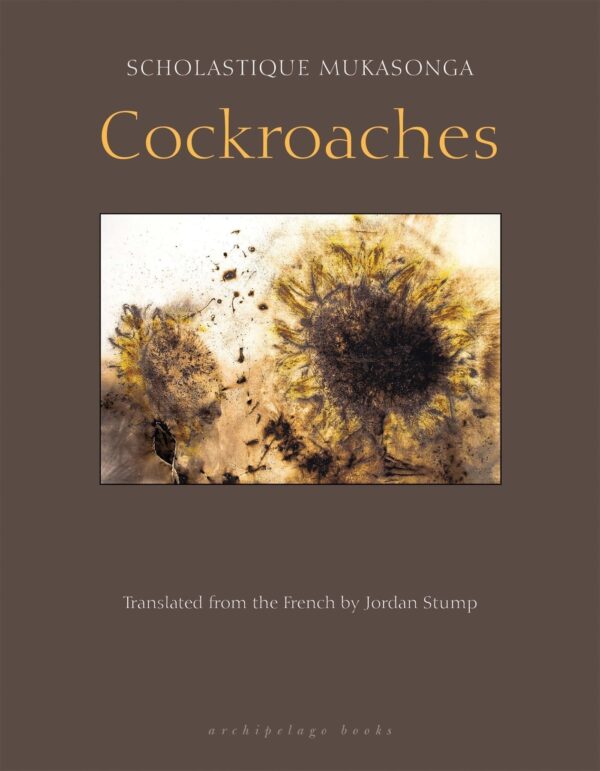
For many, writing serves to maintain memory. Autobiographies lend themselves to this kind of writing most; whether they are diaries tucked beneath one's bed or lengthy journals carefully composed to preserve personal history. In either case, such writing formulates our lives into the morphing branches of books, reaching the mind of a single person or innumerable peoples spanning countries if not continents. While reading the stories born of this kind of writing, I find that the intensity carried by the writer is often lost to me. Details that should strike me as intimate or private--irreducible in their particularity--fade beneath the ambiguities of language. Scholastique Mukasonga's Cockroaches is striking, then, for maintaining this intensity to her reminiscences; and fusing the contrasts between the horrors of genocidal oppression with the stunning obliqueness of life after surviving it.
This works, perhaps, because Cockroaches isn't purely autobiographical in its endeavours. Mukasonga recalls the traumatic experiences of her life not just for the confessional expression of pent-up sentiments, but also as a way to do justice to the dead. Mukasonga's narrative is as much a retelling of the events leading to the 1994 Rwandan genocide as an active resurrection of its victims. In the letters of the page, friends and family lost to cruelty and prejudice breathe again, their words echoed by the reader. However, this process of revival remains soaked in terrible trauma, grief that pains the hand of its writer:
All I have of my loved ones' deaths are black holes and fragments of horror. What hurts the worst? Not knowing how they died or knowing how they were killed? The fear they felt, the cruelty they endured, sometimes it seems I now have to endure it in turn, flee it in turn. All I have left is the terrible guilt of living on amid so many dead. But what is my pain next to everything they suffered before their tormentors granted them the death that was their only escape?
Recollection here isn't purely soothing. Images from the past, coloured by the hindsight of events to come, become excruciating, memorial vacuums after intense suffering. Mukasonga's account is gripping because of this excruciating difficulty, hard to read as it must have been to write. The book demands attention with the dying cries of the innumerably powerless.
Various stories that deal with the dehumanization of such conflicts employ naming as a means of restoring agency to victims. Homeric critics argued this point most famously for The Iliad, noting how soldiers in their dying moments inspire glimpses into their person, origins, and aspirations. Mukasonga does this also, reciting "the names of all those who have no one left to mourn them." Unlike the case of Homer, restoring humanity to those lost to brutal, senseless massacres is not only painful, but itself somewhat disillusioning. "I cry out their names," Mukasonga writes in revisiting her village, "to whom? for whom?" The question hangs, lingering as the paragraphs that follow tell the person's contributions, their characteristics, who they were and how Mukasonga knew and recognized them. In these final pages, the people become more than nameless bodies tossed into mass graves, but people with different lives, hopes, and dreams.
I imagine many will find Cockroaches too harrowing to read. Certainly, it seems that readers of the modern age love nothing more than books that provide the stairway to escape the horrors of the reality. One of the imaginative wonders of the book, however, is its capacity to reframe the tremors of history into the context of our lives. The current trajectory of our own nation towards warmongering makes such lessons all the more important to remember. Amidst all the horror and despair, Mukasonga still closes her eyes and restores the dead their place in life. "In the bright night of my memory, they're all there." No one battles the storms and wins, and the ensuing forest fires claim all too many lives; yet beneath the ash-layered floors are always survivors. "No genocide is perfect." Traces remain of those lost to oblivion, floating as innocuously through the air as snakes weave through the thickets of overgrown homes.
Kang, Han. The Vegetarian (Trans. Deborah Smith). Hogarth Books 2015.
Review Written and Edited by Peter Buller
Vegetarianism is paradoxically bound to both escape life's cruelties and further one's connection to it; or, maybe this is just my projection of those with carnivorous lifestyles. Regardless, this remains a contradiction that will incessantly mar the path of those pursuing vegetarianism, in spite of the plethora of (possibly) sound reasons to avoid eating meat. Our preoccupation with the consumption of flesh or vegetable manner seems to only complicate the connection between life to the sacred, rather than resolve the tension of life's double-bind to violence and intimacy. Han Kang's Booker prize-winning novel, The Vegetarian, explores the murky nuances of this contradiction. Her novel examines vegetarianism through the primal, animalist influences pulsing through our veins, and basks in the dark resplendence of the dream world.


