Review Written and Edited by Peter Buller
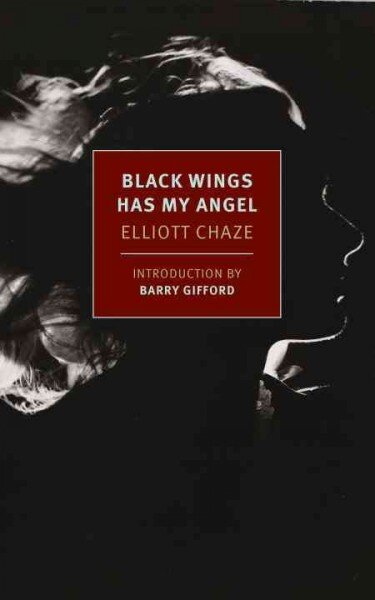
Noir depicts the unsavory lifestyles of crime and debauchery through a lucid lens. Whether this contributed to the amoral philosophizing among the early films of Jean-Luc Godard, or the dark-hearted catharsis of the films that inspired Godard, the result was a gray scene with worldly cynicism as the presiding ideology. The free-flighted morality necessary to maintain this thematic cloud looming overhead required constant movement, and so, the noir work rarely dealt with place as anything more than fleeting: the undefined sight of a town flashing by a car racing off to nowhere. Such ease of movement makes possible the opening sequence of Welles' The Touch of Evil, and the plentiful opportunities for mischief in Godard's Pierrot le Fou. The fleeting nature of settings for the noir work establishes a culture of placelessness, the environment most suitable for the growth of skepticism. Perhaps for this reason, Elliott Chaze's Black Wings Has My Angel stands alone among noir works today. The remarkable succinctness of his prose orients noir cynicism toward the anxiety of living in a home that isn't home, or more crucially, a home that is only "home."
Chaze manages this by conveying a simple crime story through the obsessive account of a nostalgia-addled veteran-turned-criminal. Chaze's blunt sentences and trite phrasing lend him comparisons to Ernest Hemingway, both of whom ascribe to an unflinching dedication to a condensation of language. Tim's digressions early in the novel align to Hemingway's literary practice, especially as he ridicules "the woman-starved nest of culture" of his former university, "where freshmen wear nauseatingly cute beanie caps, where no one walks on the hallowed grass, and everyone is so sporting it hurts." It is a cynicism Tim reserves for nothing and no one, not even his country, "the land of the free and the home of the brave." Skepticism with nationalism and patriotism sings the noir tune; yet for Tim, the "country" he worries about is not the one overbearing most noir heroes. The country tipping his paranoia over the edge is of sprawling "sky and clouds," one of "being able to move around" that makes him into "something of a fool about the outdoors." The conceit to Tim's freedom is its dependence upon the cover it provides for his operations. Although this seems true to the broader sense of noir works, Black Wings twists the expectation by placing Tim's freedom in the country. For most noir works, the country is a space of highways, gas stations, hotels, and small jobs. It is strictly transitory. Thus what makes Tim and Virginia's downfall intriguing and inevitable--which are only sometimes the case with noir works--is their mutual failure to settle down (in both senses of the term). Chaze's novel concerns the crime less than the days, weeks, and months afterward. The time spent in preparation, the tension spent baiting one's breath as the moment to act draws closer like storm clouds looming ever nearer, occupies the majority of Chaze's novel.
In this sense, Chaze perhaps owes much to For Whom the Bell Tolls, which also builds on the same anxiety of anticipation; yet while Hemingway's refined descriptions illuminate a plot of conflict, whereas Chaze's obsession with detail gravitate towards a conflict of plot. Tim's deliberation on the account of his crime revisits the mirage conjured by his hyper-attentive focus, an illusion manifested by his ever-deepening faith in cynicism and greed. This sleight of hand by which Chaze pens Tim's slow descent resembles Hemingway's texts as much as Alain Robbe-Grillet's. Black Wings aims for a different mark than the literary objectivity Robbe-Grillet's Jealousy, However, the obfuscation of the actual narrative through its own authorial description powers Tim and Virginia's spiraling retread through the crime scene they thought they left behind. Perhaps this allusion to Robbe-Grillet is more than thematic, given Tim's delusions regarding Virginia's polygamous adventures:
She wore a light yellow corduroy dress and it was cut down to the small of her back.... there was plenty of space for him to cover. When he tired of one spot he moved on to another, his hand busy as a tarantula in a fly cage. I can't describe the way it made me feel. But I'd never seen anyone else touch her and you can say what you want, but the things you think, the things you actually see, are altogether different.
Tim's jealousy does not form into a tarantula, as the nameless narrator of Jealousy encounters his in the vibrating, chattering husk of a centipede; nor is jealousy the churning heart of Chaze's text. Tim's anxiety manifests as "a hole the size of the Katie Lewellyn," and the uncertainty of what lies in its depths a "hideous magnet" that drags them down in "a slow sickening whirl." The real impetus of Tim's desires--for Virginia, for his world, and for himself--consume themselves through his own expression of their complexities. The criminal dream of escaping the scene of the crime to enjoy its luxuries looms over Tim's every conscious move, and the pursuit of this dream proves more than his match.
Helping his descent into this dark pit is Virginia, whose cunning depiction earns Chaze more credit for Black Wings than he ever earned. The female partner-in-crime to the male lead of noir works tends towards the feminine wiles of a femme fatale or the allure of a damsel in distress; and usually, only bothering to characterize women as one or the other. The former will crush goons beneath six-inch heels and shower bullets upon those in hot pursuit, only to fall uselessly in her partner's hands as soon as the "edge" of cynicism brandishes its blades again. Despite noir works holding cynicism towards the cities and the governments running them, the men running off to fight crime for crime's sake seemed afraid of nothing but women assuming any power in the conflict. Curiously, Virginia seems to fit neither mould. She never finds herself at Tim's mercy in any real way, as his "rescues" are from men she elects to meet, which culminate in her amusement with his heroic antics. She also lacks the rigid determinism necessary to commit to her own heroics, evident by her flight from the gunfight where Tim needed her most. Virginia lacks the grounded determinism to stay "a tough, elegant adventuress with plenty of guts," while being self-assertive and independent enough that Tim remains "scared to give her freedom." Her embrace of Tim's desire for a place of placelessness takes on new meaning given that, for him, she personifies this space. If love describes their relationship, then it makes their plunge all the more fitting, hugging one another and laughing as fissures from their crime open up around them.
Thus Chaze twists the control over one's death--another noir favourite--into Tim's ultimate downfall. For the tragedy of his story hinges upon a reversal of misfortune, and a negativity inspired from the very thoughts conjured to prevent his premature end. Unlike the conclusion to most noir works, there is no ride into the horizon, no crashing and going up in smoke, nor even explosives rigged for a haphazard suicide. There is no liberation, neither in the optimism of a sunrise nor the pessimism of a conflagration. Instead Chaze offers the slow crawl of dawn, a revelation unfolding like a paper crane taking flight. Through skillful subtlety and a cracked desire for freedom, he illustrates the catharsis of reaching for an impossible dream; a fallen angel trying feebly to stretch its broken, black wings.

No comments:
Post a Comment